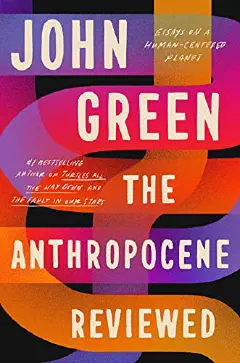
I came to this book backwards. Years before reading it I listened to every episode of the podcast it came out of, and that was during COVID, when we were still living in Toronto. I’d go out for night walks in the middle of a frigid Canadian winter with John Green in my ears. His voice is sorrowful and calming at the same time, which turned out to be roughly what I needed that year.
So reading the book was mostly nostalgia. I should say that up front, because it probably inflated my rating.
What it is
Short essays about pieces of the human-centered world, things like Halley’s Comet, Diet Dr Pepper, the QWERTY keyboard and sunsets, each ending with a rating out of five stars. The conceit is tongue in cheek and I don’t think Green takes it particularly seriously either. It’s a frame to hang the essays on, and the essays are the point.
Highlights from the book
Looking back at what I marked, almost all of it is about loneliness. That wasn’t deliberate, but it isn’t surprising either. I read it from that angle, and I think Green writes from that angle most of the time.
The one I’ve repeated to the most people is about bears. Northern Europeans avoided saying their actual word for bear, possibly because naming one might summon it, and the avoidance worked so completely that the original word is gone from the language. What’s left is the replacement. We’ve been calling them “You Know Who” for a thousand years and mostly haven’t noticed.
Then there’s Green trying to comfort a friend and failing:
They won’t be okay, of course, but they will go on, and the love you poured into them will go on. That’s what I should’ve said. But what I actually said, while crying, was, “How can this be happening? You do so much yoga.”
I find that one very funny and very sad, and I don’t think it works without both.
There’s a definition of personhood in here that I keep thinking about. The responsibility of being a person is recognizing personhood in others, listening to their pain and taking it seriously even when you can’t feel it yourself. It’s a demanding standard. It’s also just a description of listening properly, which is harder than it sounds and which I’m not always good at.
The one that landed most personally is Donald Hall, writing after the death of his wife, on what he called third things:
We did not spend our days gazing into each other’s eyes. We did that gazing when we made love or when one of us was in trouble, but most of the time our gazes met and entwined as they looked at a third thing.
Hall’s examples are objects, habits, arts, institutions, games, children. I think this is a genuinely useful way to look at a marriage and it rings true for mine. You’re not looking at each other most of the time. You’re looking at the same third thing together, and having good ones matters.
And one more, mostly because it made me laugh: Green quotes Matthew on it being easier for a camel to pass through the eye of a needle than for a rich man to enter the Kingdom of God, and a minister pointing out that people take every line of the Bible literally except that one, which is the only line actually meant literally.
Stable communities
The passage I’ve thought about most in a work context is Green quoting Vonnegut, writing back in 1974:
What should young people do with their lives today? Many things, obviously. But the most daring thing is to create stable communities in which the terrible disease of loneliness can be cured.
A large part of my job is building cohesion out of people who live in different countries, speak different native languages, sit in different time zones and carry different cultural expectations about what work even is. I’ve written about remote teams before, mostly about tooling and process, which is the easy part to write about.
Vonnegut is describing the hard part. You can get the tooling right and still end up with a group of people who are individually fine and collectively nothing. The daring thing isn’t the coordination, it’s the community, and I don’t think our industry has gotten appreciably better at it since 1974.
Podcast vs. book
The podcast is better. The essays were written to be read aloud by the person who wrote them, and something goes missing on the page. If you haven’t encountered either, start with the podcast and treat the book as a way to go back to the episodes you liked.
All quotes are from The Anthropocene Reviewed by John Green.