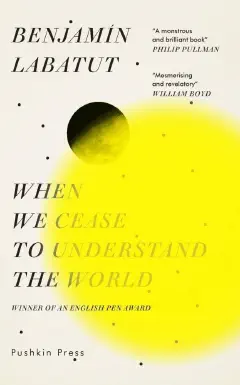
I read this about five weeks after The MANIAC, which is unusual for me. I normally space authors out. In this case I wanted to know whether the first book was a one-off or whether Labatut actually works this way, and it turns out he does.
It covers different ground, though. The MANIAC is about building a machine. This one is about the point where understanding runs out.
What it is
It’s a set of linked pieces about Fritz Haber, Karl Schwarzschild, Alexander Grothendieck, and then Heisenberg and Schrödinger. The proportion of invention goes up as the book goes on, which I didn’t notice until afterwards and thought was a nice trick.
As with the other book, Labatut researches deeply and then imagines his way into how these people felt. It makes the whole thing visceral in a way that non-fiction on the same subject rarely manages.
Highlights from the book
Schwarzschild worked out the mathematics of what we now call a black hole while serving on the Russian front, and the book has him frightened by his own result in a way that goes well past physics:
If matter were prone to birthing monsters of this kind, Schwarzschild asked with a trembling voice, were there correlations with the human psyche? Could a sufficient concentration of human will—millions of people exploited for a single end with their minds compressed into the same psychic space—unleash something comparable to the singularity?
This is the anthropologist’s move I mentioned in my note on the other book. A physicist asks what the equation means. Labatut asks what kind of society produces the person who writes it.
There is a detail I haven’t been able to shake since. On the 1st of September 1939, the same day German tanks crossed the Polish border, Oppenheimer and Snyder published the paper showing that a sufficiently heavy star must collapse indefinitely, forming the object Schwarzschild had predicted, one “capable of crumpling space like a piece of paper and extinguishing time like a blown-out candle.” Two kinds of collapse, same day.
The Heisenberg section is where the book earns its title. The uncertainty principle didn’t just add an error bar, it removed the thing determinism was standing on:
what was beyond our grasp was neither the future nor the past, but the present itself. Not even the state of one miserable particle could be perfectly apprehended.
And a little later, the replacement: “Where before there had been a cause for every effect, now there was a spectrum of probabilities.” Labatut describes the result not as a rational God pulling threads but as something closer to a many-armed goddess playing with chance, which I thought was a lovely way to put it.
The Copenhagen Interpretation gets the same treatment. Reality doesn’t sit there independently waiting to be measured. An electron has no fixed position until it’s looked at, and between one measurement and the next there is no sensible question to ask about where it is. Measured as a wave it behaves as a wave, measured as a particle it behaves as a particle, and there is no further fact underneath:
Like the moon in Buddhism, a particle doesn’t exist: it is the act of measuring that makes it a real object.
The book ends on the thing I keep coming back to. Quantum mechanics is our best theory. It’s behind the phone in your pocket and the internet and the computing we are all currently excited about. And:
there is not a human soul, alive or dead, who actually gets it. The mind can’t come to grips with its paradoxes and contradictions. It’s as if the theory had fallen to earth from another planet, and we simply scamper around it like apes, toying and playing with it, but with no true understanding.
I found that oddly comforting rather than alarming, and I’m still not completely sure why. Possibly because it is honest. We have built an enormous amount on top of something nobody can explain, and it works anyway, and admitting that seems healthier than pretending otherwise.
Which one to read first
Either, I think. I read The MANIAC first and I am glad I did, because it is the more approachable of the two and it sets up the pattern. But this one is shorter, stranger and probably the better book.
All quotes are from When We Cease to Understand the World by Benjamín Labatut.